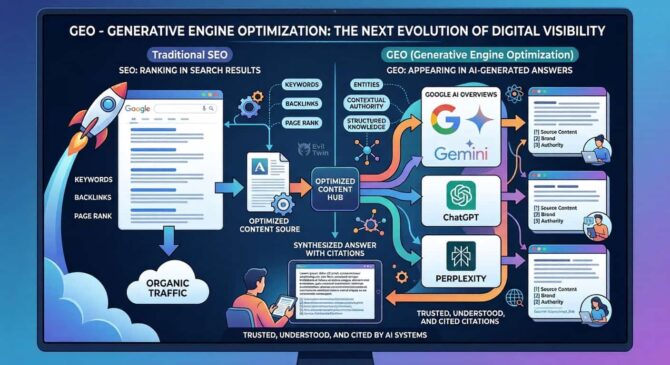


GEO – Generative Engine Optimization is the process of optimizing digital content so that AI-driven search systems such as Google AI Overviews, ChatGPT, Gemini, and Perplexity can understand, trust, and cite it inside their generated answers. Unlike traditional SEO that focuses mainly on ranking web pages in search results, Generative Engine Optimization focuses on making content visible inside AI-generated responses and knowledge synthesis systems.
Why GEO Matters in the Age of AI Search
Search behavior is undergoing the most dramatic shift since the early days of Google. For more than two decades, users relied on traditional search engines that returned lists of links ranked by relevance. Today, however, many users interact with AI-driven answer engines that synthesize information from multiple sources and present it directly as a structured response.
This shift fundamentally changes how visibility on the internet works. Instead of competing only for the top 10 results in Google, companies now compete to become trusted sources inside AI-generated answers.
This is where GEO becomes critical.
In a traditional SEO environment, success meant ranking first on a search engine results page and attracting clicks. In an AI search environment, success increasingly means:
-
Being cited in AI answers
-
Influencing the information AI models present to users
-
Becoming a recognized authoritative source for a topic
For organizations, brands, and content creators, this shift introduces a new discipline that complements traditional search strategies: Generative Engine Optimization.
GEO vs SEO – Understanding the Core Differences
The discussion around GEO vs SEO has become one of the most important conversations in digital marketing. While both disciplines aim to increase online visibility, they operate within different search paradigms.
Traditional Search Engine Optimization (SEO) focuses on improving rankings within search engines such as Google or Bing. The goal is to increase organic traffic by making a page more relevant, authoritative, and technically optimized.
GEO, on the other hand, focuses on optimizing content for AI-powered systems that generate answers rather than just displaying links.
Key differences between GEO and SEO
Output format
- SEO aims to rank pages in search results
- GEO aims to appear in AI-generated answers
User interaction
- SEO depends on users clicking links
- GEO often delivers information directly within the AI response
Content interpretation
- SEO algorithms evaluate keywords, backlinks, and page relevance
- GEO systems analyze entities, context, authority, and semantic relationships
Information synthesis
- SEO presents ranked pages
- GEO contributes to synthesized knowledge responses
Understanding geo vs seo is essential because they represent two overlapping but distinct optimization models.
GEO or SEO – Do Businesses Need Both?
A common question many marketers ask is whether they should focus on geo or seo. The short answer is that modern digital strategies require both.
SEO remains extremely important because search engines still drive significant traffic and serve as the foundation for information discovery. However, AI systems frequently rely on content that already ranks well, has strong authority signals, and is structured in ways that make it easily interpretable.
This means that Generative Engine Optimization often builds on strong SEO foundations.
Instead of replacing SEO entirely, GEO expands the optimization landscape by addressing how AI systems interpret and synthesize information across the web.
Organizations that treat GEO and SEO as complementary strategies are far more likely to maintain visibility as search technology evolves.
How AI Search Engines Work
To understand Generative Engine Optimization, it is important to understand how AI search engines process information.
Unlike traditional search engines that primarily index pages and rank them based on algorithmic signals, AI-driven systems operate differently. They analyze vast collections of documents and use language models to synthesize answers that combine knowledge from multiple sources.
When a user asks a question, an AI search engine may:
-
Retrieve relevant documents from an index
-
Extract key facts and entities
-
Compare multiple sources
-
Generate a summarized answer
-
Cite authoritative sources when appropriate
Because of this process, AI systems often prefer content that is:
-
Clearly structured
-
Factually reliable
-
Contextually rich
-
Written in natural language
-
Supported by authoritative references
These preferences are at the heart of GEO .
The Rise of AI Answer Engines
The rapid development of AI answer engines has accelerated the importance of GEO.
Systems such as ChatGPT search, Google AI Overviews, Gemini, and Perplexity increasingly act as the first interface between users and information. Instead of clicking through multiple links, users can receive a complete answer instantly.
This transformation has several implications:
-
Organic click-through rates may decline for some queries
-
Brand authority becomes more important than page rankings
-
Being cited in AI answers can become a primary visibility channel
-
Content quality and credibility become critical ranking signals
In this environment, Generative Engine Optimization ensures that content remains discoverable and influential inside AI-driven ecosystems.
GEO Instead of SEO – Is SEO Becoming Obsolete?
Some discussions in the industry frame the debate as GEO instead of SEO. However, the reality is more nuanced.
SEO is not disappearing. Search engines continue to index billions of pages and rely on ranking systems to organize information. AI systems also depend heavily on traditional search indexes when retrieving documents.
However, the role of SEO is evolving.
Rather than optimizing solely for rankings, content creators must now also consider:
-
AI comprehension
-
entity recognition
-
contextual authority
-
structured knowledge
In practice, the future of search will likely involve SEO evolving into a broader discipline that includes GEO principles.
Core Principles of Generative Engine Optimization
Successful Generative Engine Optimizationrequires aligning content with the ways AI systems interpret information.
While traditional SEO often focused heavily on keywords, GEO focuses on semantic clarity and knowledge structure.
Important GEO principles
-
Entity clarity
-
clearly define organizations, people, technologies, and concepts
-
-
contextual completeness
-
provide thorough explanations rather than isolated keyword fragments
-
-
structured knowledge
-
organize content using clear headings, sections, and logical flow
-
-
source credibility
-
reference reputable information sources
-
-
expert authorship
-
demonstrate subject matter expertise
-
-
consistency across platforms
-
maintain accurate brand presence across websites, publications, and profiles
-
These elements help AI systems identify trustworthy information sources and increase the likelihood that content will be referenced.
How to Optimize Content for GEO
Creating content for GEO – Generative Engine Optimization requires a shift in how content is written and structured.
Instead of optimizing only for search algorithms, content must also be optimized for machine understanding.
Effective GEO content strategies
-
Start with clear question-based headings
-
Provide concise answer summaries early in the article
-
Expand topics with deep contextual explanations
-
Include relevant examples and case studies
-
Link to authoritative sources
-
Maintain logical content hierarchy
Another important tactic is to ensure that articles are written in natural language that mirrors how users ask questions. AI systems often rely on conversational queries, which means content that reflects real questions is more likely to match AI retrieval patterns.
Technical Optimization for AI Visibility
Technical infrastructure also plays an important role in Generative Engine Optimization.
While GEO is primarily about content clarity and authority, several technical factors improve the ability of AI systems to access and interpret information.
Technical GEO elements
-
structured data markup (Schema.org)
-
semantic HTML structure
-
accessible content formatting
-
fast loading pages
-
crawlable architecture
-
strong internal linking
Structured data helps machines understand relationships between entities such as organizations, products, people, and services. When implemented correctly, this structured information strengthens both SEO and GEO performance.
Building Authority for GEO
Authority plays a critical role in determining whether AI systems trust and cite content.
While backlinks remain important signals, authority for GEO often comes from broader digital presence.
Authority signals that support GEO
-
media coverage and digital PR
-
expert authorship
-
academic or research citations
-
brand mentions across trusted publications
-
industry recognition
-
consistent brand knowledge panels
When AI models repeatedly encounter a brand associated with specific expertise, they are more likely to treat that brand as a reliable information source.
Measuring Success in Generative Engine Optimization
Unlike traditional SEO, where success is often measured through rankings and organic traffic, GEO requires additional metrics.
GEO performance indicators
-
citations in AI-generated answers
-
visibility in Google AI Overviews
-
mentions in AI-driven search tools
-
brand recognition within AI responses
-
increased authority signals
Monitoring these signals helps organizations understand whether their Generative Engine Optimization strategy is improving their visibility within AI ecosystems.
The Future of GEO
As artificial intelligence becomes the primary interface for discovering information, GEO will become a core discipline of digital marketing.
Future search environments will likely combine:
-
traditional search engine rankings
-
AI-generated answer interfaces
-
conversational search experiences
-
multimodal information synthesis
Organizations that invest early in GEO – Generative Engine Optimization will be better positioned to influence how information about their industry, products, and expertise is presented by AI systems.
Rather than viewing geo instead of seo as a replacement strategy, forward-thinking companies will integrate both approaches into a unified visibility strategy.
Frequently Asked Questions About GEO
What is GEO in digital marketing?
GEO (Generative Engine Optimization) is the practice of optimizing content so AI systems can understand, trust, and cite it within generated responses.
What is the difference between GEO and SEO?
The difference between geo vs seo lies in their goals. SEO focuses on ranking web pages in search results, while GEO focuses on making content visible inside AI-generated answers.
Should businesses focus on GEO or SEO?
Most organizations should implement both. The question is not geo or seo, but how to integrate them into a single strategy that ensures visibility in both search engines and AI platforms.
Is GEO replacing SEO?
No. Although some discussions frame the debate as geo instead of seo, in practice GEO expands SEO rather than replacing it.
Why is Generative Engine Optimization becoming important?
As AI search systems become widely adopted, visibility within generated answers becomes a key channel for brand awareness and information discovery.
Conclusion – Why GEO Is the Next Evolution of Digital Visibility
The evolution of search technology is reshaping how information is discovered online. As AI systems become the primary gateway to knowledge, businesses must adapt their strategies to ensure they remain visible and authoritative in this new environment.
GEO – Generative Engine Optimization represents the next stage of digital visibility. It focuses on making content understandable, trustworthy, and valuable not only for human readers but also for AI systems that synthesize and deliver information.
Organizations that embrace Generative Engine Optimization early will gain a significant advantage. They will shape how AI platforms present knowledge, build authority within their industries, and ensure that their expertise becomes part of the global information ecosystem.
If your organization wants to remain visible in the era of AI-driven search, developing a strong GEO strategy is no longer optional.
Evil Twin helps companies navigate this new landscape by combining advanced SEO expertise with cutting-edge Generative Engine Optimization strategies that position brands for success in AI search environments.
If you want your brand to appear not just in search results but inside the answers generated by AI systems, it may be time to rethink your digital visibility strategy. Evil Twin can help you lead the future of search.